
8 Midwestern Universities launch SF Hub; Partech Impact €300M inaugural fund; Europe's largest Fusion facility; AI Agent deployed to renew subscriptions!
Insights from the DeepTech Universe

Hey Everyone 😊Founder-VC Vibe is back with another DeepTech pulse.
Over the past couple of weeks, a lot has been quietly unfolding across the ecosystem from major funding rounds, innovative ideas moving to market-ready products and strategic fund launches to deeper signals around where capital is actually moving.
This brief is a quick attempt to cut through the noise and focus on what matters:
who’s getting funded, what’s gaining momentum, and what it tells us about the future of DeepTech.
Let’s dive in….
Global Market is concentrating!
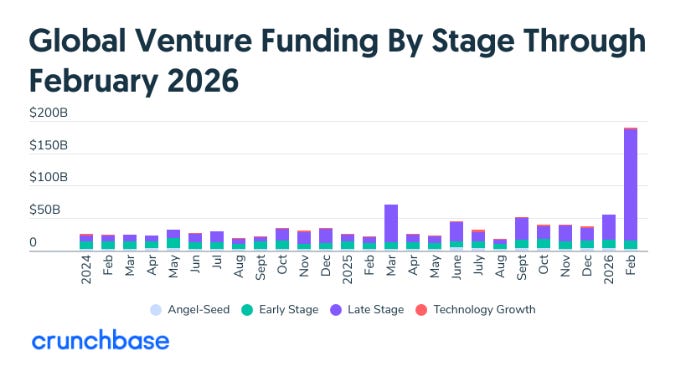
Global venture investment totalled $189 billion in February ‘the largest startup funding month ever recorded’ — although 83% of capital raised went to just three companies. All told, venture investment was up close to 780% year over year from the $21.5 billion raised in February 2025.
###1.Major Funding Rounds 🪙
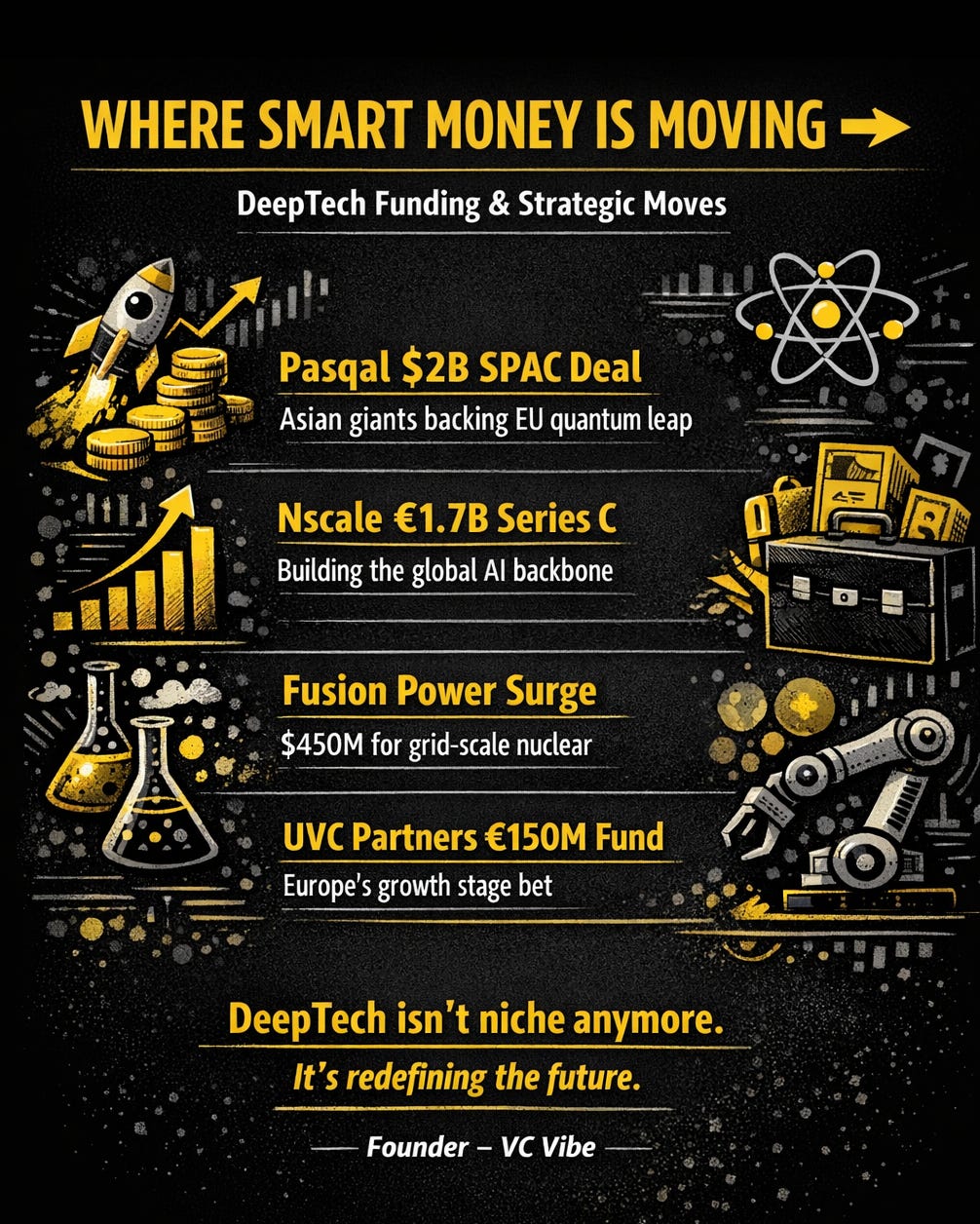
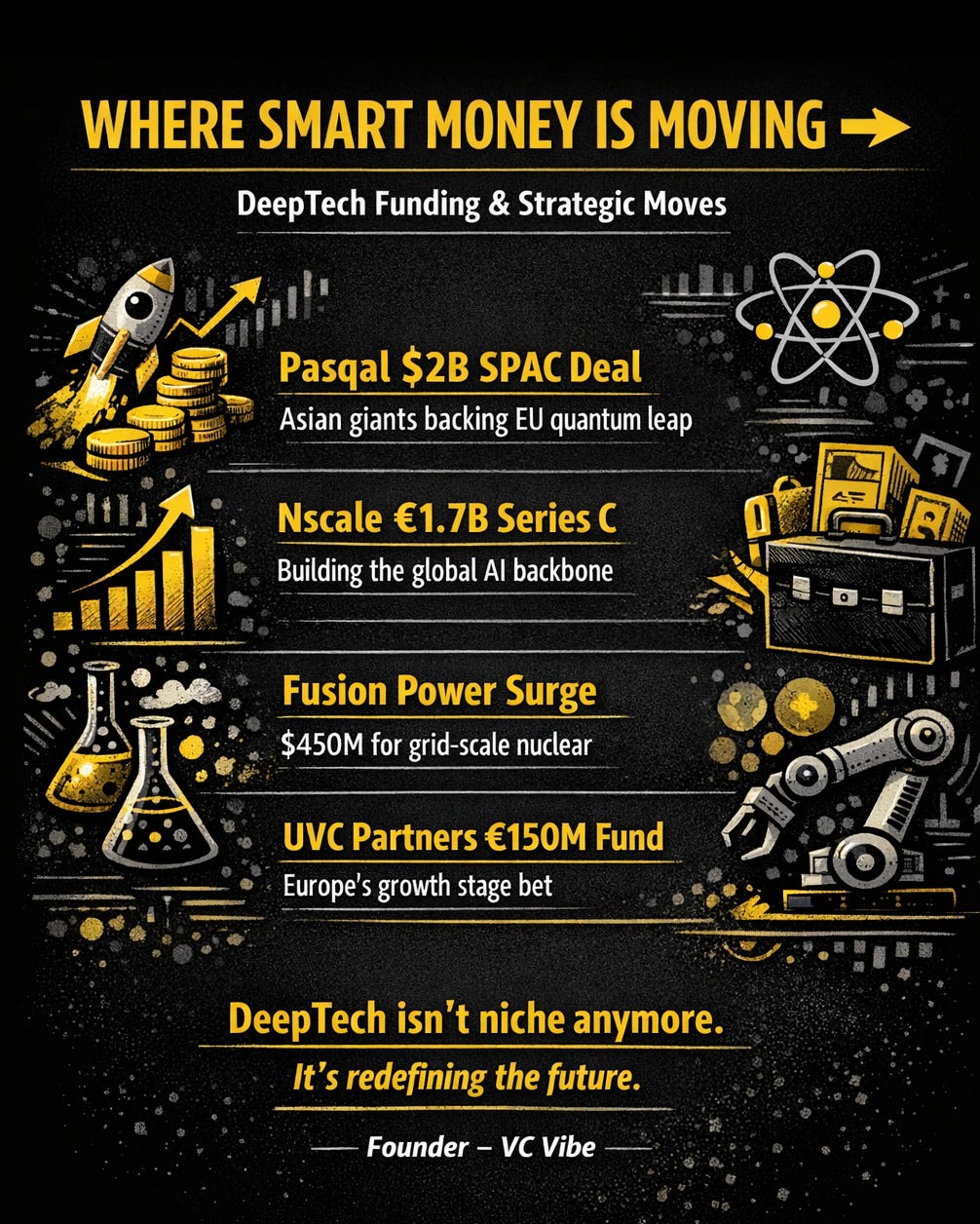
Pasqal’s $2B Nasdaq Leap: In a definitive milestone for European DeepTech, French neutral-atom quantum leader Pasqal announced a $2B SPAC merger with Bleichroeder Acquisition Corp II. This includes a massive $395M private round from Quanta Computer and LG Electronics, signaling that Asian industrial giants are now the primary backers of European hardware scale.
Nscale announced its €1.7 billion ($2 billion) in Series C funding: To further accelerate Nscale’s global development of vertically integrated AI infrastructure from GPU compute and networking to data services and orchestration software – across Europe, North America, and Asia. The round was led by Aker ASA and 8090 Industries. This round values Nscale at €12.6 billion ($14.6 billion).
Nuclear Energy Lifts Off ⚛️: The "30-year joke" about fusion has been retired as capital shifts from physics experiments to grid-scale industrialization. The standout signal is Inertia Enterprises’ $450M raise (led by Bessemer & GV), aiming to commercialize the ignition physics and Thunderwall, the world’s first grid-scale fusion laser beamline with a pilot plant targeted for 2030. Other strong signals include Helion Energy (backed by Sam Altman) and Commonwealth Fusion Systems with over $1B and $2.8B raised respectively targeting grid delivery timelines as early as 2028. Pacific Fusion ($900M Series A) de-risking faster paths to commercialization, and TAE Technologies heading for a $6B public listing.
### 2. Strategic Fund Launches
New funds are filling the “homegrown late-stage gap,” particularly in Europe and the US Midwest.
UVC Partners (Munich) - €150M Growth Fund: Focused on robotics, nuclear (Proxima Fusion), and dual-use tech. This marks a shift toward multi-stage investing, ensuring European DeepTech champions don’t have to flee to the US for Series B/C capital.
Breakout Ventures (San Francisco) - $114M Fund III: Doubling down on the convergence of biology and computation. Their thesis: DeepTech isn’t just “hard”; it’s now providing the most consistent, scalable returns in the bioeconomy.
Third Coast Foundry (Cross-Regional): Eight Midwestern universities (including UChicago and Purdue) launched a San Francisco hub. This is a strategic “bridge” to move research innovation from the “Lab-to-Fab” by connecting Heartland IP with Bay Area venture networks.
Partech (Global): The global technology investment firm, headquartered in Paris, with offices in Berlin, Dakar, Dubai, Milan, Nairobi, and San Francisco, announces the final closing of its inaugural Partech Impact Fund, securing €300 million in total commitments to scale European B2B tech transforming global value chains.
### 3. Ecosystem Partnerships 🫱🏻🫲🏻
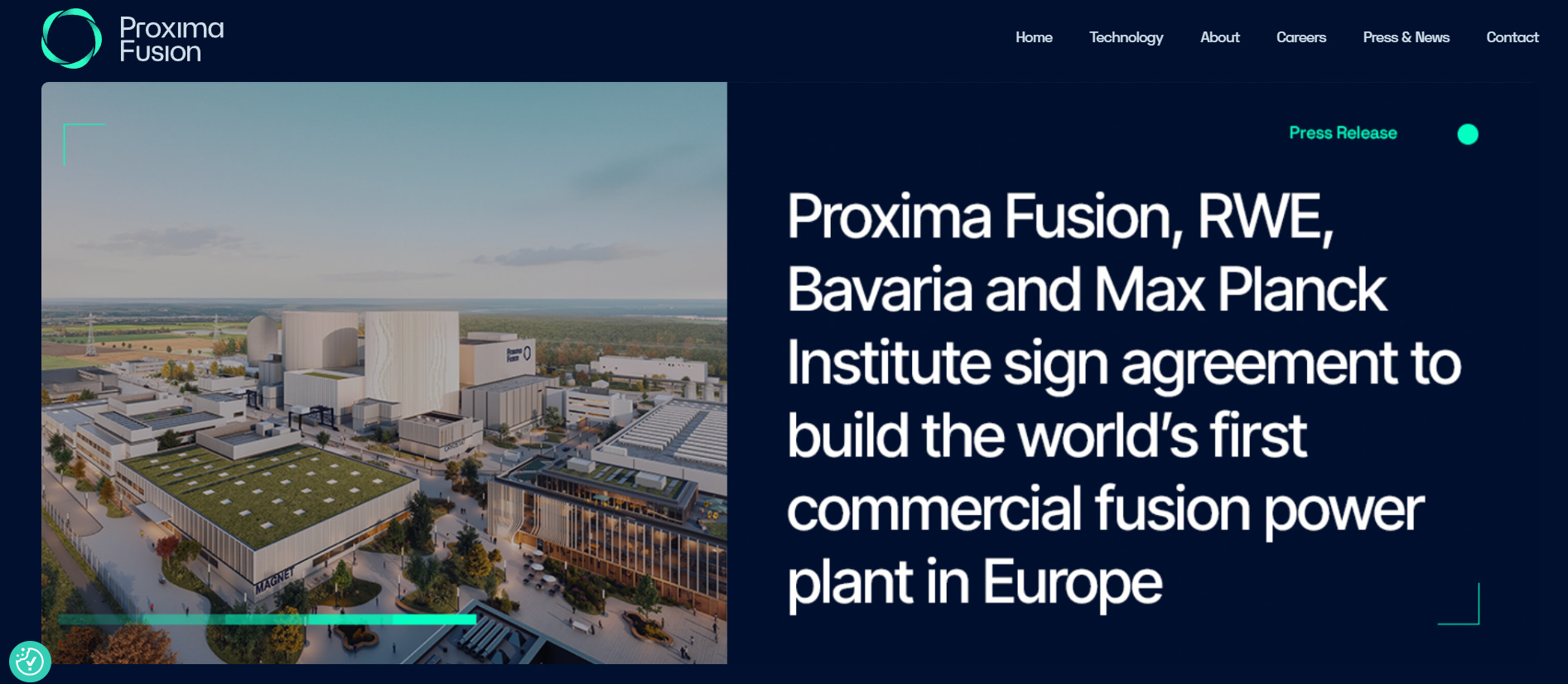
Proxima Fusion launches Europe’s largest fusion test facility.
Proxima Fusion in Germany is spearheading “Project Alpha”, a €2 billion fusion test facility as part of a broader surge in European deeptech. The initiative places Germany at the centre of a new stellarator-based approach to fusion that optimises magnetic cages for high-energy particles. Proxima Fusion, a Munich-based startup and the first spin-off from the Max Planck Institute for Plasma Physics (IPP), is actively working on developing high-temperature superconductor (HTS) stellarator fusion power plants.
The Great Calibration: Why the West’s Medical Future Will Be "Made in China"
The global biopharma landscape is witnessing a massive strategic shift as Deeptech innovation in China becomes a primary engine for pharmaceutical pipelines. In 2025, out-licensing deals from the region hit a staggering $137.7 billion, with 2026 projections already showing a 76% jump in average deal size. Faced with looming patent cliffs and rising R&D costs, global giants like AstraZeneca, Novartis, and AbbVie are aggressively securing rights to China-developed molecules. This surge in high-value ecosystem partnerships underscores a transition where China is no longer just a manufacturing hub, but a dominant source of the specialized chemistry and molecular research driving the next generation of global medicine.
India-Japan Startup Corridor: Meaningful global pathway for Deeptech Startups
T-Hub and JETRO announced the creation of a High-Impact Innovation Corridor, a structured, bilateral platform connecting India's startup ecosystem with Japan's advanced R&D and industrial infrastructure and provide entry support.
Startup collaboration to provide market access for Japanese entities in India and expansion pathways for Indian startups in Japan, through exchanges, investments and corporate tie-ups.
Will cover AI, Blockchain, IoT, Cloud, Advanced Manufacturing, Space, Defence, Mobility, Smart Infrastructure, Pharma and Medical Equipment.
Includes startup exchanges, investor connects, regulatory guidance and open innovation with firms like NEC, Suzuki, Panasonic and Toyota.
### 4. What else caught my attention!
AI Agent Renews Subscriptions: Utah announced a first-of-its kind pilot program allowing an autonomous artificial intelligence (AI) agent to renew prescriptions for consumers who request it. Many patients face physical+cost barriers to visiting a physician to renew prescriptions. Doctronic’s pilot program is trying to solve that problem, the pilot program is expected to become one of the first deployments at scale of an autonomous, agentic system in medicine.
AI > SaaS: NFX argues AI will fundamentally outscale the SaaS era by re-architecting how value is captured across every layer of the global economy.
Hydrogen’s Industrial Leap: Hydrogen-electric aviation is moving beyond prototypes into the “execution phase,” marking a pivotal shift for zero-emission regional transport infrastructure.
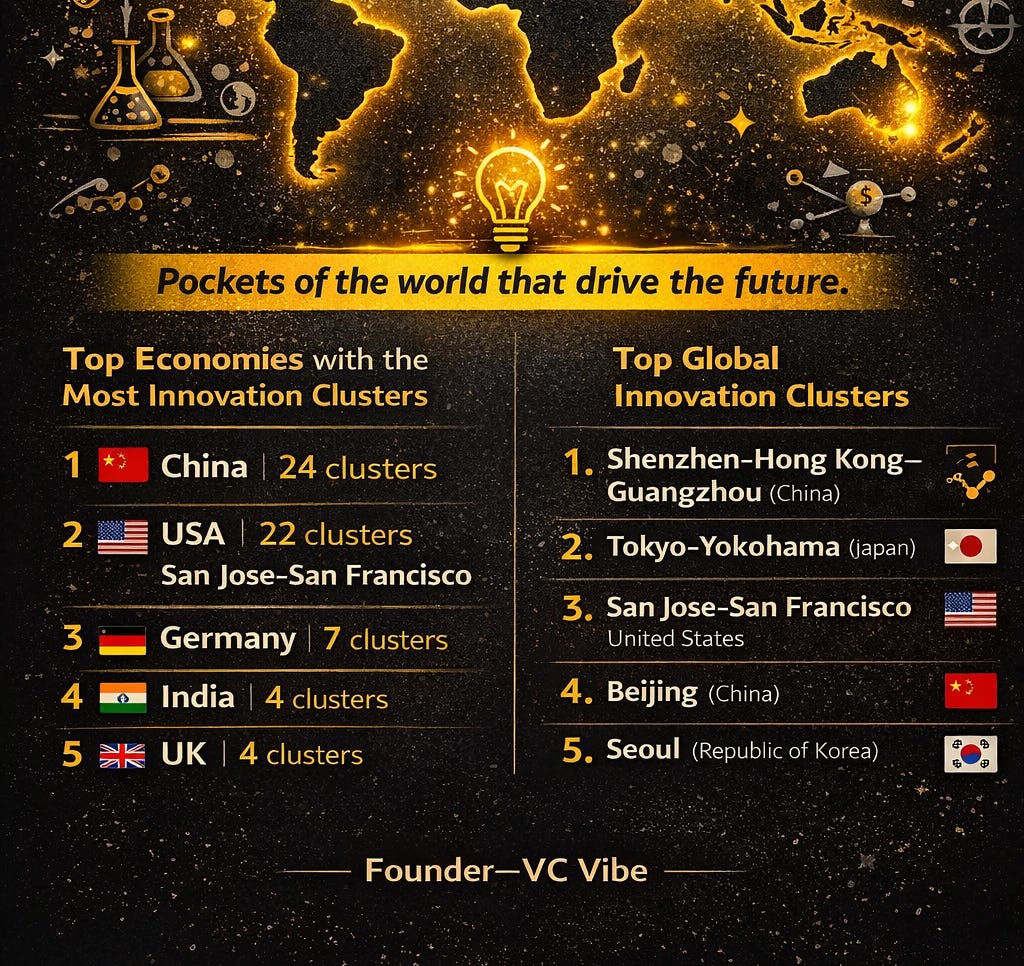
GII 2025: The latest Global Innovation Index rankings confirm a shift toward a “polycentric” world, with emerging economies rapidly closing the gap on established tech hubs.
The 20-Year Moat: By extending DeepTech recognition to 20 years, India has created a global first in “temporal arbitrage,” providing the structural patience required for quantum and advanced materials.
Europe’s long-awaited proposal: The European Commission made public the EU Inc. 28th regime, a corporate legal framework that enables companies to be incorporated across all 27 member states within 48 hours, fully online and at minimal cost.
While the initiative, modeled on the Delaware framework in the US promises faster company formation and cross-border scalability, however critics argue it falls short of a true single European standard. Key concerns:Still relies on national courts and registries
Lacks a fully unified legal framework
Risks creating 27 variations instead of one system
### 5. ‘Words of Wisdom’
The best way to raise money is not to need it.” - Marc Andreessen
Fundraising, at its core, is a game of leverage. Building a self-sustaining business through revenue and product-market fit is superior to relying on external funding.
When founders focus on building real traction including users, revenue, or undeniable product pull — capital shifts from being something you chase to something that chases you. Read the related post here:

In venture, scarcity attracts attention.
But inevitability attracts capital.
### 6. Picks from the Substack Universe
A premium business caught between durable economics and a less forgiving market, a post by Europe Capital
There’s nothing left in the tank by Anna | how to boss AI
Contrasting the view of AI thought leaders, the weekly download by Kenny Fraser
Why robots still struggle with simple tasks by The Generalist Mario Gabriele
An AI Tool That Evaluates AI Tools and helpful insights by Cash & Cache
Gartner’s 2026 Forecast, shifts that define the who WINS by Juan Salas-Romer
Stepping back, a few patterns are becoming hard to ignore.
Capital is concentrating but conviction is deepening.
The biggest rounds are no longer chasing ideas; they are backing infrastructure, physics, and systems that reshape industries.
At the same time, ecosystems are evolving in parallel:
Europe is building retention mechanisms for its DeepTech champions,
Asia is emerging as a capital and industrial backbone,
and countries like India are quietly designing long-term structural advantages.
We are witnessing a reconfiguration of how innovation is built, scaled, and owned globally.
DeepTech is moving from experimentation to execution — from lab breakthroughs to balance sheet decisions.
And the next phase will be built by founders who can commercialize, scale, and integrate into real-world systems fastest.
More to track in the coming weeks.
If you found these insights valuable, please consider sharing this brief with a founder, investor or your colleague. Helping this signal reach the right people is how we grow.
Thanks for reading! 🙌
Thanks for the mention! I've just subscribed — awesome work!
Thanks for the shout out Charu! 🤗